
This blog outlines several key exceptions we often rely on for existing buildings undergoing remodels or alterations that allow projects to proceed without upgrading insulation to the most stringent current energy code requirements.
On renovation projects, improving insulation can be an important part of the design—but in some cases it can be cumbersome, disruptive, and disproportionately expensive. While energy efficiency is always a priority, it doesn’t always make sense to require $50,000 in insulation upgrades for a $10,000 remodel. This post highlights the code-recognized exceptions intended for exactly these types of situations, helping balance practical feasibility with responsible energy performance.

ASHRAE exceptions- Wall and Roof Insulation
We can go to ASHRAE 90.1 to find exceptions for wall and roof insulation.
2018 IECC C401.2 allows USE OF ASHRAE 90.1 to comply with energy code. So, we can utilize ASHRAE 90.1 instead of the IECC as an alternate compliance path.
2022 ASHRAE 90.1: 5.1.4 , EXCEPTION, ITEM 4:
ASHRAE 90.1- 5.1.4 Alterations to Building Envelopes. Alterations to the building envelope shall comply with the requirements of Section 5.2 for insulation, air leakage, and fenestration applicable to those specific portions of the building that are being altered.
Exceptions to 5.1.4: The following alterations need not comply with these requirements, provided such alterations will not increase the energy use of the building:
In summary, For walls- where there is no existing framing cavity and no new framing cavity is exposed, the wall can remain as is. This is often the case in older buildings with brick, masonry or stone walls. For roofs, as long as the cavity is insulated to at least R-3 per inch and the entire cavity is filled, that is compliant.
ASHRAE 90.1 can be used as an alternative compliance path and would apply to existing buildings undergoing alterations whether or not there is a change of occupancy, as this code does not have separate provisions for occupancy changes.
IECC exceptions- Wall and Roof Insulation
2018 IECC (Int’l Energy Conservation Code) -C503.1- states that the following does not need to meet the current energy code standards for new construction:
In summary, the IECC allows wall, roof and floors to remain as is, and if cavities are exposed, then they can also remain as is if already filled with insulation.
Note, the IECC exceptions only apply for alterations, not necessarily a change of occupancy. If there is a change of occupancy, IECC C505.1 applies which triggers code upgrades when the new occupancy involves an increase in energy use.
Case Study
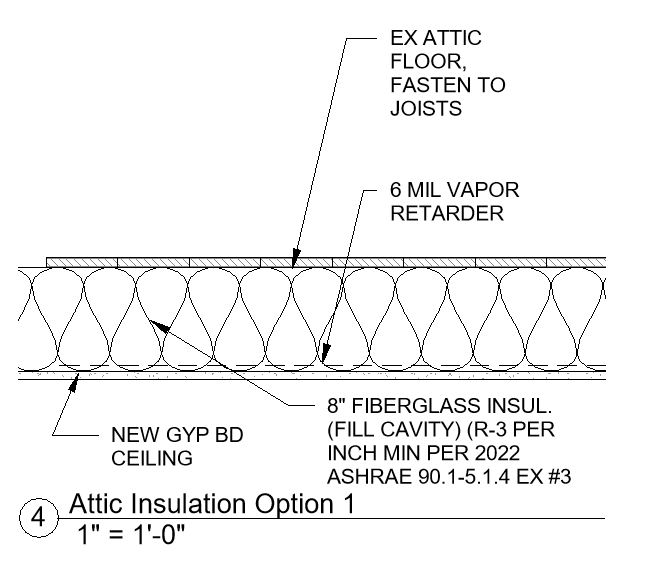
A very old Pennsylvania church we worked on had an attic on it, and stone walls. There was no insulation in the attic or walls. The walls could remain as is, since no new cavities were exposed. For the attic, we added insulation to the existing 8″ attic floor cavity with R-3 per inch, easily achieved with standard batt insulation
Conclusion
The compliance methods in this post primarily revolve around the building envelop walls and roof. Other considerations for energy compliance may still apply, such as lighting, HVAC, plumbing, etc.