
When it comes to barrel storage facilities, we are often asked what the sprinkler density requirements are. Barrel storage facilities often house large quantities of flammable liquids and a properly designed sprinkler system is very important to the safety and compliance of the facility.
There are 3 main paths that we usually explore for barrel storage facilties, outlined in this article.
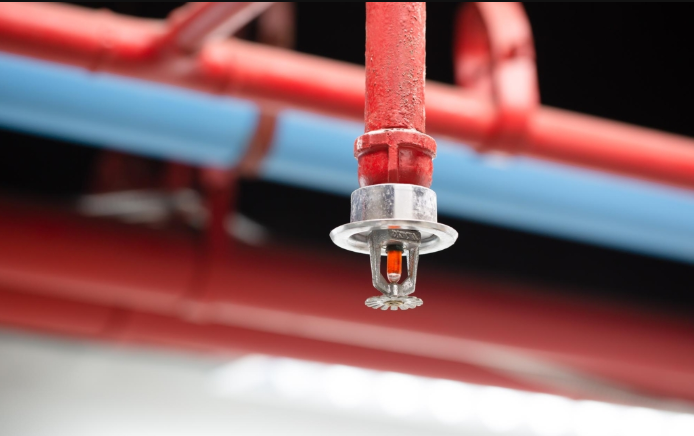
NFPA 13 is the standard for sprinkler systems. Unfortunately, barrel storage of alcohol is not called out in NFPA 13, the standard for sprinkler systems. But, if we do utilize this standard, we utilize hazard group EH2 (extra hazard 2) for barrel storage. Per the 2019 edition of NFPA 13, 4.3.6, Extra hazard 2 criteria includes “spaces with substantial amounts of combustible or flammable liquids”. While “substantial” is not defined, we do typically classify anything over the MAQ’s (maximum allowable quanitites), or flammable liquid, which is 240 gallons in a sprinklered building, to be substantial.
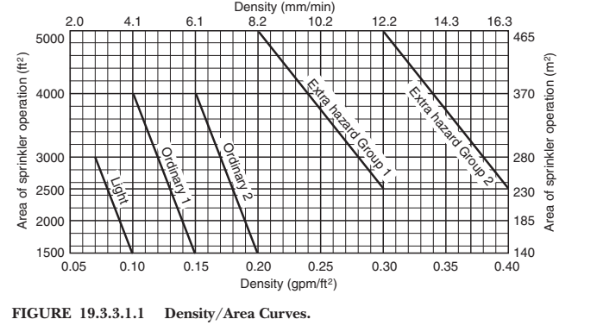
Then, we often utilize Figure 19.3.3.1.1, density area curves to determine the sprinkler density. The chart below shows extra hazard 2 at a density of 0.40 gpm per sf, with an area pf sprinkler operation of 2,500 sf. You can use a lower density, but the area of sprinkler operation goes up.
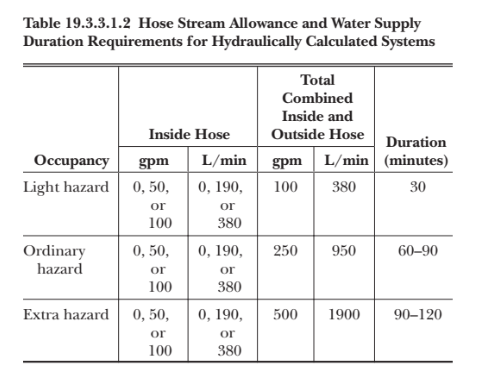
In addition to the density, a hose stream must also be added in to the required water supply, which is 500 gpm combined inside and outside hose, for a duration of 120 minutes, as shown per the table below.
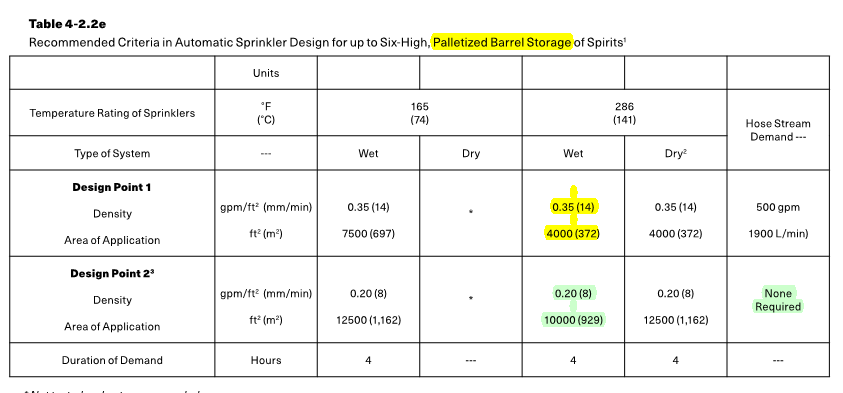
Another standard we often turn to is the “Recommended FireProtection Practices for Distilled Spirits Beverage Facilities” by DISCUS. This DISCUS publication recommends various fire protection & safety measures for distilleries, including barrel storage
Table 4-2.2e shows density for palletized storage, which is often used. As shown below, we typically use 0.35 gpm per sf over 4000 sf area, with a 500 gpm hose demand. This density is similar to the NFPA 13 requirement.
Alternatively, if using a racking system, such a wooden rick storage, a different table applies, taking into consideration the height of the storage. As shown below, lower storage, up to 6 tiers, only require 0.22 gpm per sf of 4000 sf. Higher tier rack systems often require in rack sprinklers as well.
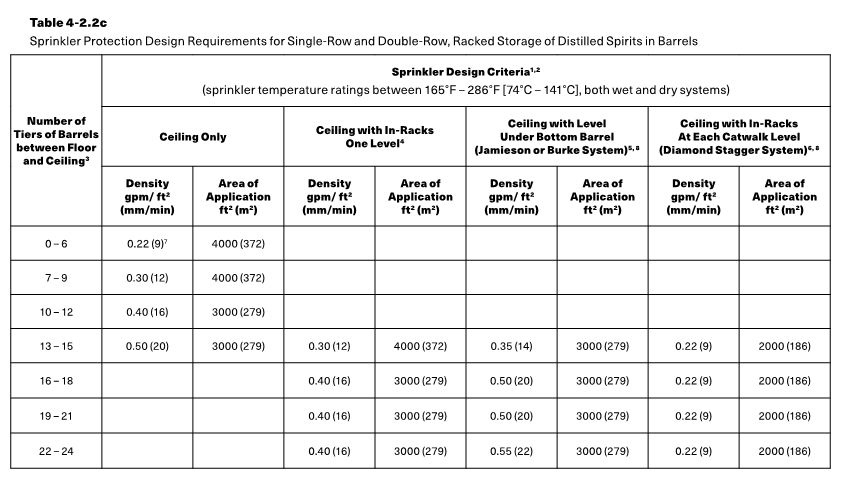
For the rack storage, hose stream is not required, often resulting in a lower overall water demand. This is not an exhaustive display of all the storage scenarios, so further research may be needed! For example, the above rack storage is for single and double row racks, with another separate chart for multiple row racks.
FM Global is a large commercial property insurer that, unlike most insurers, does hands-on engineering and loss-prevention research — it publishes its own technical standards (the “Data Sheets”) that tell insured facilities how to design and protect their buildings against fire and other property risks, and often ties insurance terms to compliance with them.
Data Sheet 7-29 specifically is the engineering standard covering how to safely store ignitable (flammable/combustible) liquids in portable containers — including barrels.
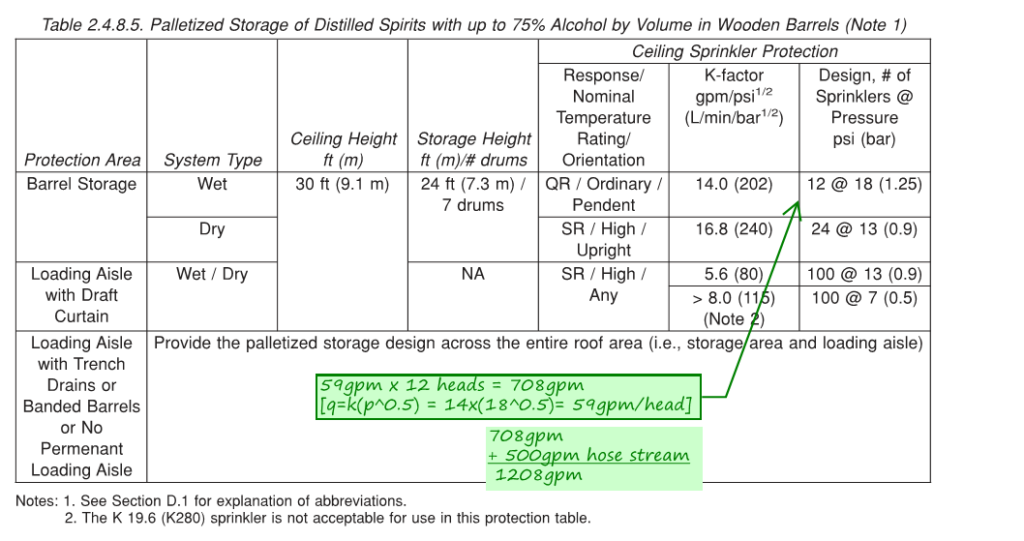
Table 2.4.8.5 tells us sprinkler density methods for palletized barrel storage areas. Under a typical wet system, palletized up to 24 ft, it specifies a K factor of 14 and a design of 12 sprinkler heads at 18 psi. Using the formula q=k(p^0.5), we get 59 GPM per head. 59 gpm * 12 heads = 708 GPM, plus a required 500 gpm hose stream= 1,208 gpm.
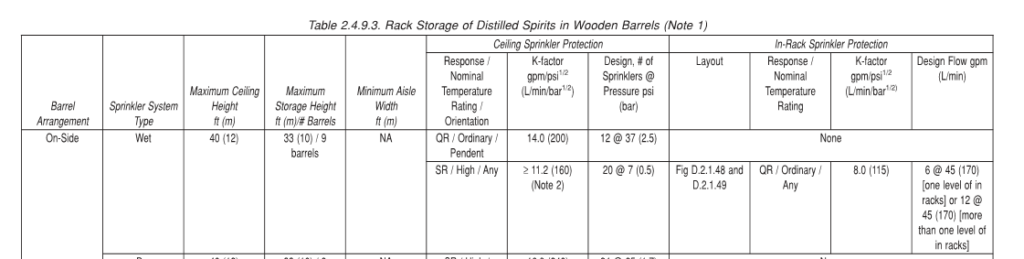
FM Data Sheet 7-29 also has a separate table for rack storage, shown below.
Of the 3 standards mentioned in this article, determinng the sprinkler density most appropriate for your project will need to take into account many factors, including water available, whether it is by public system or tank, storage area, storage height, and storage method (rack or palletized).