
When you store or use bulk volumes of flammable liquid outside, there are regulations per the IFC (international fire code) that come into play. Many distilleries may store or even process flammable liquids outside and here are the main rules!
This post references the 2021 edition of the IBC and IFC.
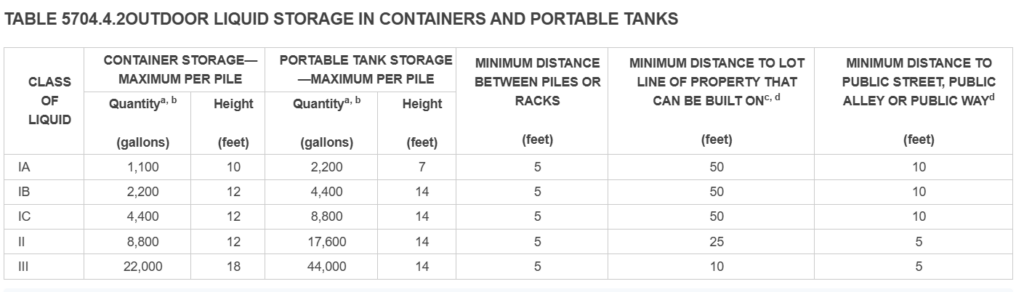
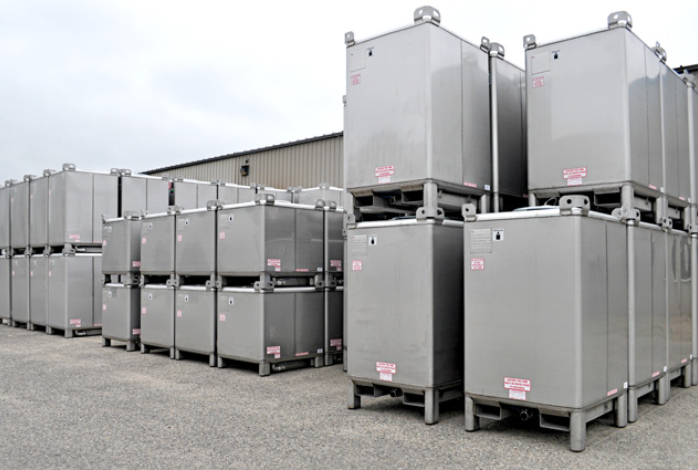
When storing outside, in portable containers or portable tanks, section 5704.4 of the IFC is triggered. Table 5704.4, below, shows us that when storing flammable liquids in containers, the setbacks, max volumes, and max pile sizes. Distilleries, storing over 20% ABV would be classified as IB or IC flammable liquid.
The main issue we usually have to address here is the 50 ft setback to lot lines. This also applies when adjacent to buildings per 5704.4.2.4. If you cannot meet the 50 ft setback next to a building, then you need to have a 2 hour rated wall adjacent to this outdoor storage.
Another major requirement for this is spill control, which is required We get referred back to 5004.2 for containment. 5004.2.2.4 tells us that outdoor containment needs to account for volume of the largest vessel, plus the volume of 24 hours of rain as determined by a 25 year storm. This usually adds a few inches to the contianment height depending on location.
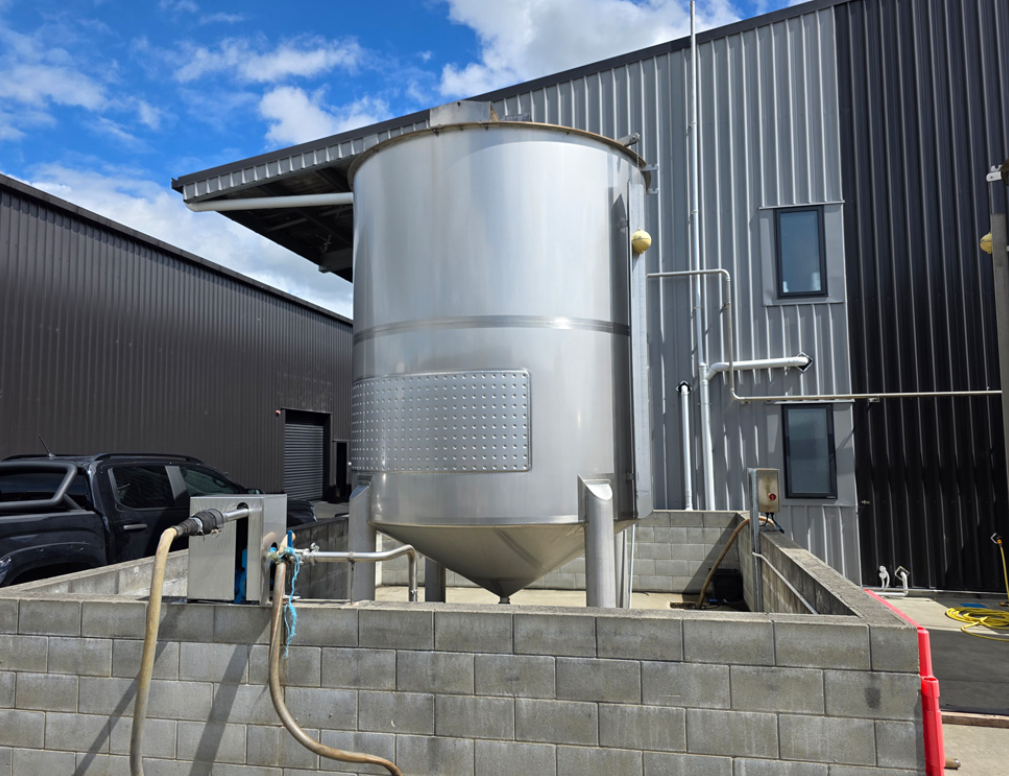
Outdoor Storage in fixed vessels/ tanks
The rules for fixed/ stationary tanks and vessels have different requirements. Surprisingly, the setback requirement is much less then that for portable containers.
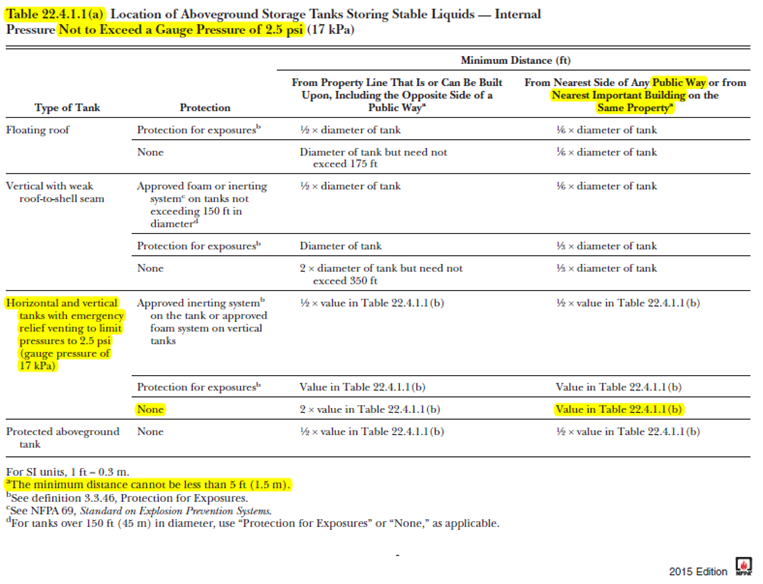
IFC 5704.2.9.6.1.1 refers us to Table 22.4.1.1(a) of NFPA 30. This table, below, shows that tanks, under 30,000 gallons shall just be 5 ft setback from the nearest important building.
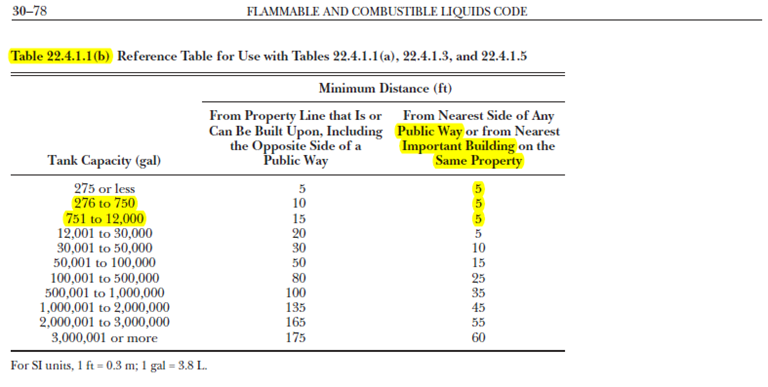
It is important to note that fixed tanks are also subject to shell to shell separation, which for the sizes we are typically dealing with distilleries (relatively small, well under 30k gallons), it is typically 3 ft. So, basically tanks need to have 3 ft separation b/t them. This rule also applies indoors.
The same secondary containment requirement as mentioned above for portable containers also applies for fixed vessels outdoors. It is essentially the largest vessel, plus 24 hours of rainfall per the 25 year storm rate. Storm rates can be looked up via NOAA here: https://hdsc.nws.noaa.gov/pfds/.
Outdoor processing/ use would include operations such as distilling, blending, etc. These are the rules for that outside!
IFC 5705.3.8 covers this category. 5705.3.8.2 tells us that dispensing operations need to happen at least 15 ft from buildings, 25 ft from building openings and lot lines. Excpection #2 to this section actually exempts water miscible liquids from these setback rules, so ethanol water mixtures outside for dispensing operations would actually not have any setback requirement.
We are also referred to 5703.4 for spill control for outdoor processing. This leads back to the same section for containment as above.
All the outdoor types of storage and use of flammable liquids can have weather coverings (roofs) overhead. As long as they meet the rules below, they are still considered outdoor storage. If these rules are exceeded, then the storage or use would essentially be considered indoors and none of the above regulations would apply, rather seperate indoor rules would apply.
Basically the roof covering needs to be noncomustible, be under 1500 sf, and not have more than 25% of the perimeter walled off! Of course, if a roof covering is involved, then the rainwater does not need to be accounted for in the secondary containment volumes, just the largest vessel.