
If you’re designing or permitting a small bar, wine tasting room, coffee shop, or intimate restaurant, there’s a building code classification question that can meaningfully change your project’s cost and complexity: is it Group A or Group B?
The instinct is often to call anything where people gather to eat and drink an Assembly occupancy. And sometimes that’s right. But the 2021 International Building Code (IBC) draws a clear line at 50 occupants — and if your space stays on the right side of it, you may be operating as a Business occupancy (Group B) rather than an Assembly occupancy (Group A-2), with real very different requirements for egress, door hardware, and construction requirements.
IBC Section 303.1 defines Group A-2 as assembly uses intended for food and drink consumption — restaurants, banquet halls, nightclubs, bars, and taverns. These are your classic “assembly” spaces.
But Section 303.1.2 carves out an important exception:
“A room or space used for assembly purposes with an occupant load of less than 50 persons and accessory to another occupancy shall be classified as a Group B occupancy or as part of that occupancy.”
Read that carefully. If your assembly area has a calculated occupant load under 50 persons and is accessory to another use, it classifies as Group B — Business — not Group A-2. This isn’t a variance or a special approval. It’s the base code.
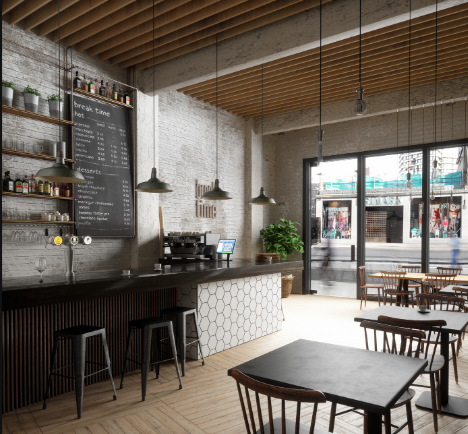
What does “accessory” mean in practice? A tasting room that’s part of a brewery or winery. A coffee shop attached to an office building. A small bar within a hotel. Even a standalone small bar or café can qualify if it reads as accessory to a retail or business function. The intent is that the space’s primary purpose isn’t large-scale public assembly — it’s a smaller-scale gathering incidental to a business operation.
Occupant load is calculated per IBC Table 1004.5. For assembly areas with tables and chairs — your typical bar or restaurant seating — the factor is 15 gross square feet per occupant. That means a space needs to be roughly 750 gross square feet of seating area before it hits 50 people. A cozy tasting room with a 400 SF seating area? That’s about 26 occupants. Solidly Group B.
This is where the classification change has real teeth. The requirements that shift most significantly involve means of egress — specifically, the number of exits and door swing direction.
IBC Section 1006.3.3 governs the minimum number of exits for assembly occupancies. Group A spaces are subject to more stringent thresholds: an A-2 occupancy requires a minimum of two exits once the occupant load reaches 50 or more, and the arrangement and travel distance requirements are tightly regulated.
Group B occupancies follow Section 1006.3.2 instead. A single exit is permitted for Group B spaces with an occupant load up to 49 persons, provided the travel distance to the exit doesn’t exceed 75 feet (per Table 1006.3.2). For a compact tasting room or neighborhood coffee shop, that’s often entirely achievable — meaning one compliant exit door may be all that’s required where an A-2 classification would have mandated two.
This has direct design implications: you may not need to punch a second egress door through your building envelope, coordinate with adjacent tenants for a shared corridor, or add a second exit stair on a multi-story space. For tenant improvements in existing buildings, this alone can be a significant cost and feasibility difference.
This is the one that catches people off guard.
IBC Section 1010.1.2 requires that egress doors swing in the direction of egress travel — that is, outward — when serving a room or space with an occupant load of 50 or more persons.
The logic is crowd safety: in a panic situation, a door that swings outward can be pushed open by the force of people pressing against it. An inswinging door in the same scenario becomes a lethal bottleneck.
For Group A-2 occupancies at or above the 50-person threshold, outswinging doors at exits are essentially mandatory. This affects hardware (panic bars required), frame conditions, and sometimes the exterior landing and door clearance requirements under Section 1010.1.6.
For your small Group B space with fewer than 50 occupants? Section 1010.1.2 does not trigger. The door can swing inward. That may seem like a small thing, but in a tenant improvement where you’re inheriting an existing door frame and storefront system, flipping a door swing can mean new framing, new hardware, repouring a landing, and ADA reconfiguration. Avoiding it matters.
Here’s how this plays out for common project types:
Small tasting room (craft brewery or winery): A 500 SF tasting area at 15 SF/occupant yields 33 people — Group B. One exit, inswinging door permitted, business occupancy construction requirements.
Neighborhood coffee shop with seating: A 600 SF seating area calculates to 40 occupants. Still Group B. Simpler egress, no outswing mandate.
Intimate cocktail bar: 700 SF of floor area with bar seating. Depending on how seating is arranged and whether some area is standing-room, occupant load may still come in under 50. Worth calculating carefully rather than defaulting to A-2.
Restaurant that tips past 750 SF of dining area: Now you’re likely at 50+ occupants. Group A-2 applies. Two exits required, egress doors swing out, and all the A-2 requirements come into play.
The 50-person occupant load threshold in IBC Section 303.1.2 is one of the most practically significant classification decisions for small hospitality and retail projects. A correctly calculated Group B classification can mean:
The key is doing the occupant load calculation right from the start, understanding how “accessory” is applied in your jurisdiction, and not reflexively defaulting to A-2 because the word “bar” or “tasting room” appears in the program. Code classification should follow the numbers — and for a lot of small hospitality spaces, those numbers land squarely in Group B territory.
All references are to the 2021 International Building Code. Local amendments may modify these thresholds. Always verify with your Authority Having Jurisdiction.
Article By: Matthew Taylor-Rennert