
Dalkita Architecture & Consulting · Building Code Series · IBC Chapter 7
Fire-rated construction is one of those topics that can paralyze a project if you let it. Designers often default to expensive proprietary assemblies listed in UL directories, not realizing the International Building Code provides a fully prescriptive, calculated method for demonstrating fire resistance without any proprietary products at all. That path lives in IBC Section 722.6—and once you understand it, it becomes a powerful design tool.
This post walks through what Section 722.6 is, how it works, what it takes to build a compliant fire-rated wall under it, and where designers commonly go wrong.
Chapter 7 of the IBC governs fire and smoke protection features. Most designers are familiar with Section 703, which outlines how fire resistance can be demonstrated—via testing per ASTM E119, via a listing in an approved directory, or via calculated methods approved by the building official.
Section 722 is titled “Calculated Fire Resistance,” and it provides prescriptive tables and formulas for determining the fire-resistance rating of a wall, floor, column, or beam assembly based on its components and construction. Section 722.6 specifically addresses wood-framed and mass timber assemblies, including light-frame wood stud walls protected by gypsum board and other membrane materials.
Section 722.6 offers a code-compliant alternative to tested assemblies—meaning you can demonstrate fire resistance from first principles, using your own material selections, without relying on any third-party listing.
This is especially useful when you’re working with non-standard framing dimensions, unusual cavity conditions, or multi-layer assemblies that don’t match an existing UL design precisely.
The calculated method in Section 722.6 is additive. It assigns a Fire Resistance Time (FRT) value to each layer of a wall assembly, and those times are summed to arrive at the total rating. The key subsections to understand are:
Establishes that fire resistance of wood-framed assemblies may be determined by the calculation procedure in this section, and that the calculation must account for both the structural frame and the membrane protection (typically gypsum wallboard) on each face of the wall.
This is the core subsection for exterior and interior bearing or nonbearing walls. The fire resistance of the assembly is calculated as:
The fire resistance of the assembly is calculated by simply adding up the time contribution of each layer:
Add those three numbers together and you have your total rated time.
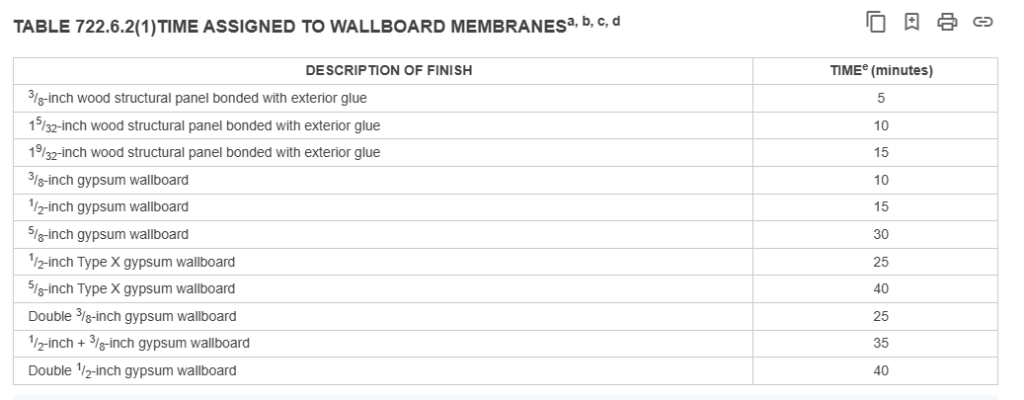
Each component time value is pulled from tables within Section 722.6. The tables account for material type, thickness, fastening pattern, and installation method. The sum must equal or exceed the required rating (60 min for 1-hr, 120 min for 2-hr, etc.).
📐 Designer’s Note The calculation is performed from the fire-exposed side inward. For a 2-hour rated wall with fire exposure possible from either side (as with most interior occupancy separations), you must demonstrate the assembly meets the rating from each face independently.
Let’s walk through a common scenario: a 1-hour interior bearing wall using 2×4 wood studs at 16″ o.c., with Type X gypsum wallboard and batt insulation.
Table 722.6.2(1), the membrane contribution of various gypsum board types is tabulated. A single layer of 5/8″ Type X gypsum board (applied per manufacturer specs with proper fasteners) contributes 40 minutes of fire resistance as a membrane.Table 722.6.2(2), the fire-resistance time contributed by the wood framing depends on the member size and whether it is load-bearing or not. 2×4 wood studs at 16″ o.c. contribute 15 minutes.Table 722.6.2(3), mineral wool or glass fiber batt insulation within the stud cavity adds additional time. 3.5″ glass fiber batt (R-13/R-15) in the cavity contributes 15 minutes.| Component | Description | Code Reference | Time (min) |
|---|---|---|---|
| T(m) | 5/8″ Type X Gypsum Board, 1 layer, fire-exposed side | Table 722.6.2(1) | 40 |
| T(f) | 2×4 Wood Studs @ 16″ o.c., load-bearing | Table 722.6.2(2) | 15 |
| T(ins) | 3.5″ Glass Fiber Batt Insulation | Table 722.6.2(3) | 15 |
| TOTAL | Sum of all components | 70 min ✓ | |
At 70 minutes, this assembly exceeds the 60-minute (1-hour) requirement with a modest margin. The assembly is compliant under the calculated method of Section 722.6.
In many cases, you’d have gypsum board on the other side of the wall as well, giving an additional 40 min (5/8″ type x)
⚠ Important Caveat These values are illustrative and based on the 2021 IBC. Always verify the specific table values in the edition of the IBC adopted in your jurisdiction, as values can vary between code cycles. Some jurisdictions may also have local amendments to Chapter 7.
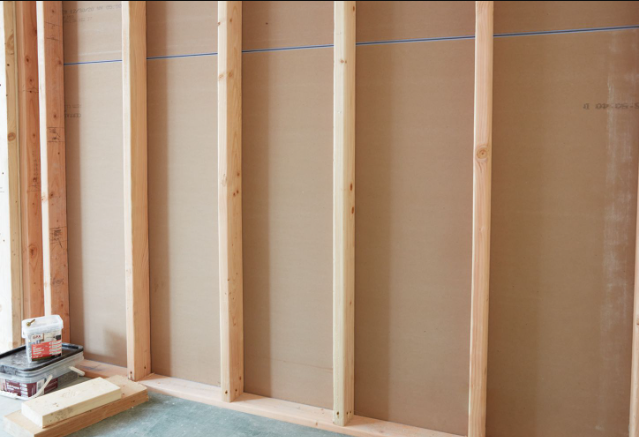
Two-hour ratings are common in occupancy separations (Group I, H, or mixed-use assemblies) and in certain construction types. Under Section 722.6, you can reach 120 minutes by layering membrane protection. Common strategies include:
Applying two layers of 5/8″ Type X gypsum board on the fire-exposed face dramatically increases T(m). Each layer’s contribution is not simply doubled—the code accounts for diminishing returns and specific fastening requirements for base and face layers—but a properly installed double layer can contribute up to 75–80 minutes on its own, depending on fastening schedule and whether resilient channels or hat channels are used.
Stepping up to 2×6 studs (or engineered lumber equivalents) increases the framing contribution per Table 722.6.2(2). This is often done anyway when wall depth is needed for plumbing runs or enhanced insulation values.
Mineral wool (rock wool) insulation typically contributes more time per inch than glass fiber due to its higher melting point and denser construction. If your assembly is running close on minutes, the insulation choice can be the deciding factor.
The calculated method is powerful, but it has important scope limitations designers need to understand before relying on it:
Section 722.6 focuses on interior fire resistance. Exterior wall assemblies with cladding, weather barriers, and continuous insulation require additional analysis—particularly where the exterior sheathing or cladding might affect the thermal performance during a fire event.
The calculation only applies to the field of the wall. Penetrations—pipes, conduit, ducts, electrical boxes—must be addressed separately through firestopping assemblies per Section 714, and opening protectives (doors, windows) per Section 716. A perfectly calculated wall loses its rating the moment an unprotected conduit passes through it.
Section 722.6 also contains provisions for mass timber elements (glulam beams, CLT panels), but these follow a different calculation methodology—typically a char-rate approach—and are distinct from the light-frame provisions above. If you’re working on a Type IV-A, IV-B, or IV-C mass timber project, you’ll need those subsections specifically.
Fire resistance rating does not mean structural performance under fire conditions is automatically met. For load-bearing assemblies, the IBC requires that the wall maintain structural integrity for the rated duration. The calculated method addresses heat transmission and flame propagation; your structural engineer should be consulted on member adequacy under elevated temperature loads for critical applications.
One of the most underappreciated aspects of the calculated method is how to present it on construction documents. Unlike a UL listing number that fits in a keyed note, a Section 722.6 calculation requires clear documentation. Best practices include:
💡 Pro Tip Some jurisdictions allow—or even prefer—the calculated method over proprietary listings because it gives the plan checker a transparent, verifiable path to compliance. Front-loading your documentation with a clear calculation table can actually accelerate plan review.
The real value of Section 722.6 is that it decouples fire-resistance compliance from product specifications. You’re not locked into a particular manufacturer’s gypsum board brand, a specific proprietary fastener pattern, or an assembly that was tested in 1987 with now-obsolete materials.
This matters when you’re working in jurisdictions with supply chain challenges, designing for remote or island locations where specialty products are difficult to source, or when you need an assembly to accommodate unique structural conditions that don’t match any tested assembly exactly.
It also matters for value engineering. When an owner pushes back on costs, being able to demonstrate that a compliant 1-hour wall can be achieved with standard materials and standard framing—calculated from the code itself—gives you a defensible, cost-effective alternative to expensive proprietary systems.
IBC Section 722.6 is one of the most practical and underutilized tools in the fire-protection designer’s toolkit. It rewards designers who understand it with flexibility, cost control, and clean documentation—without sacrificing code compliance. The next time a project calls for a fire-rated wood-framed wall, consider whether the calculated path might serve you better than reaching for the UL directory by default.
If you have questions about applying the calculated method to a specific project, or need a code analysis prepared for permit submittal, Dalkita Architecture & Consulting can help. We work across multiple jurisdictions and IBC editions and are experienced in producing thorough, plan-check-ready fire-resistance documentation.
Disclaimer: This post is intended for informational purposes and reflects the provisions of the 2021 International Building Code. Always verify the applicable code edition adopted in your jurisdiction and consult with a licensed design professional before making project-specific decisions. Local amendments may modify the applicability of Section 722.6.
Dalkita Architecture & Consulting · Article By: Matthew Taylor-Rennert
Code Intelligence Series · dalkita.com