This post referenced National Building Code of Canada (2020 Edition), and the National Fire Code of Canada (2020 Edition). Certain provinces, such as Ontario and British Columbia adopt their own versions of these codes with amendments, but most of the regulations mentioned here should still apply- check your locally adopted code amendments.
Distillery Occupancy is either a High hazard or Medium- Hazard Instrustrial Occupancy (F1 or F2 in Canada). So which is it? Well, it depends on several factors!
In the NBC (National Building Code), “Distilleries” are listed as an example under Group F, Division 1 (F1) Occupancy, per A-3.1.2.1.1(1). Also, we need to look at the various industrial occupancy definitions found in section 1.4 of Division A of the NBC offer some insight into the occupany-


These definitions are important, but the Fire Code offers additional details specifically geared toward distilleries that we must utilize!
The following passage is the primary one used to determine whether a distillery is going to be F1(High Hazard) or F2 (Medium Hazard) Occupancy.

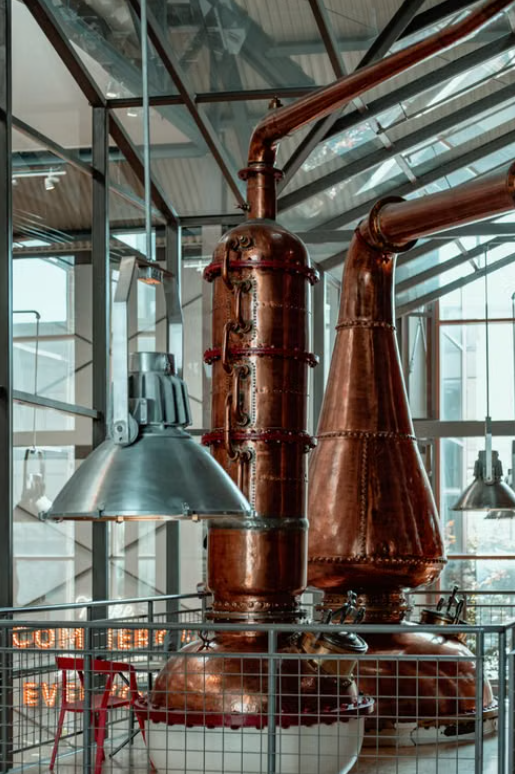
Basically, if you have an actual distilling process, it will certainly be an F1 (High Hazard) Occupancy. Also, if you store alchohol in bulk, that also triggers the F1 (High Hazard) occupancy designation. Unfortunately, the code does not define what it considers to be “bulk”. But, we interpret it to be storing >20% ABV in a fixed tank, which is defined to be vessels over 60 gallons.
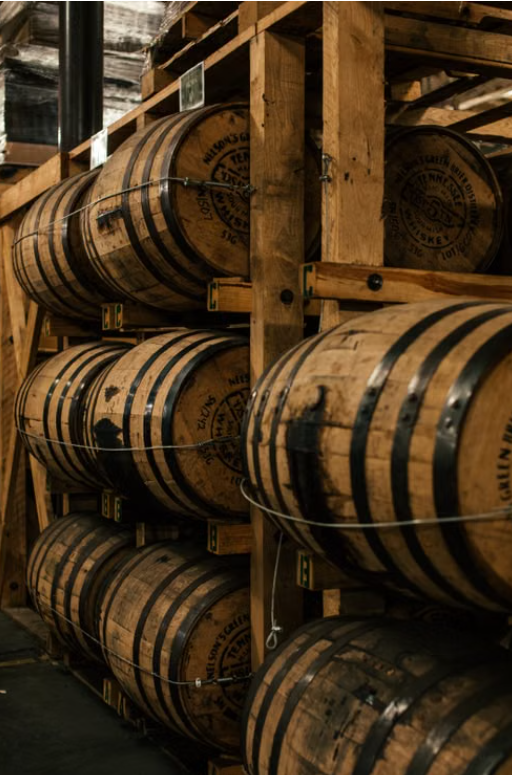
If you have a part of the distillery that is for the storage only of alcohol, in “containers”, which we interpret to be portable vessels under 60 gallons, then that would be considered a medium hazard occupancy (F2). So, this would be barrel storage, for example. There is not a Maximum Allowable Quantity to this such as found in US based codes.

F1 (High Hazard Industrial) is prohibited from being in the same building as an A (Assembly), B (Detention), or C (Residential) major occupancy. This can present as a challenge, when a distillery wants to have a tasting room in the same building.
But, we can utilize the definition of Major Occcupancy, to allow a smaller tasting room to be a part of the same building as a distillery. The defintion, shown below states that a major occupancy shall be deemed to include subsidiary occupancies that are an intergral part of the principal occupancy. So, a tasting room may be considered to be intergral and subsidiary to the distillery. It cannot function without the distillery. This is open to some interpretation. A much larger tasting room/ restaurant, relative to the distillery may need to be in a separate building from the distillery. In some projects, we create two separate “buildings” via a firewall that extends through the roof and is designed to withstand a fire on one side while not collapsing for a prescribed time.