
If you’re planning a distillery, one acronym will shape your floor plan more than almost anything else: MAQ, or Maximum Allowable Quantity. It sounds like a bureaucratic footnote. In practice, it’s the single number that decides whether your still room is a straightforward F-1 factory space or a High-Hazard H-occupancy — with everything that implies for fire ratings, sprinklers, ventilation, and construction cost.
This post is the “start here” primer for MAQ, based on the 2018 I-Codes — still the most common code cycle in active adoption. (A note on that below, because this is a moving target.) If you’ve read our post on using control areas to expand MAQs, this is the foundation that post builds on.
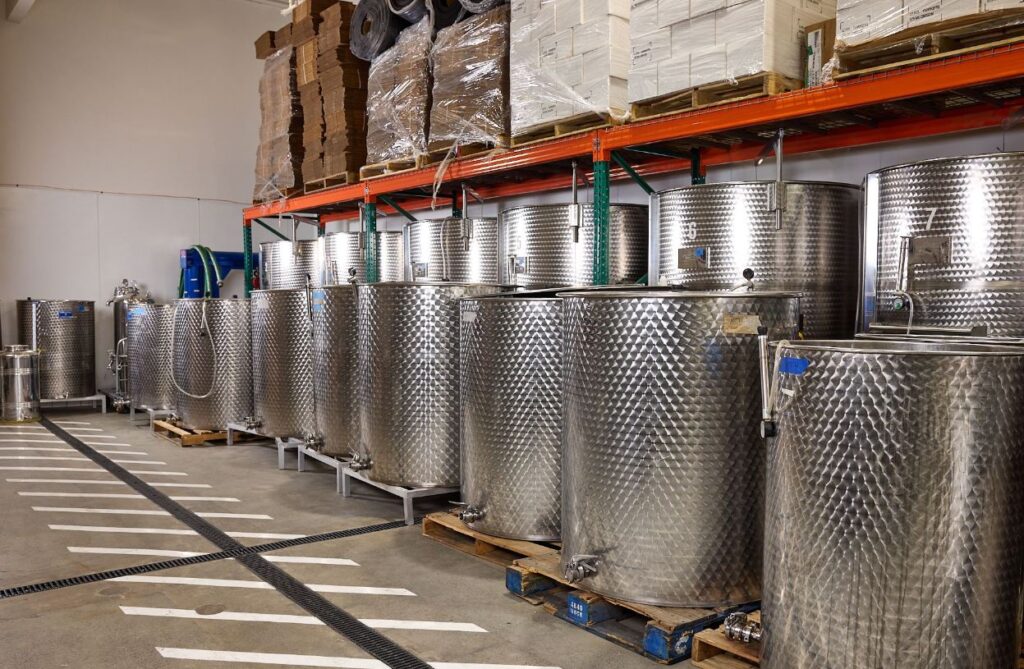
Every building code that governs hazardous materials — the International Building Code (IBC) and International Fire Code (IFC) — sets a ceiling on how much of a hazardous material you can store or use in one place before the space has to be reclassified as high-hazard. That ceiling is the Maximum Allowable Quantity.
For a distillery, the material that actually triggers MAQ is the high-proof distillate — typically classified as Class I-B or I-C flammable liquid depending on flash point and proof. One common misconception is that fermented wash counts too. It doesn’t: wash coming out of fermentation is low-proof (usually well under 20% ABV) and doesn’t meet the flash point threshold for a Class I flammable liquid, so it’s excluded from the MAQ calculation entirely. The MAQ conversation starts at the still — where proof, and flash point, cross into hazardous territory — and continues through anywhere that distillate or finished spirit is stored: barrel rooms, bottling, and bulk tank storage.
The governing table lives in IBC Table 307.1(1) (control area limits for flammable and combustible liquids), cross-referenced against IFC Chapter 57. For a Class I-B or I-C flammable liquid in a single control area, the baseline allowance is 120 gallons. Install automatic sprinklers throughout the control area, and the code lets you double that allowance to 240 gallons — one of the most consequential design levers in the whole calculation, since sprinklering a space you’d likely sprinkler anyway can be the difference between staying in F-1 and tipping into H-occupancy.
Here’s the part that surprises new distillery clients: MAQ isn’t just a number you check against on paper after the design is done. It should be one of the first constraints you design around, because it determines:
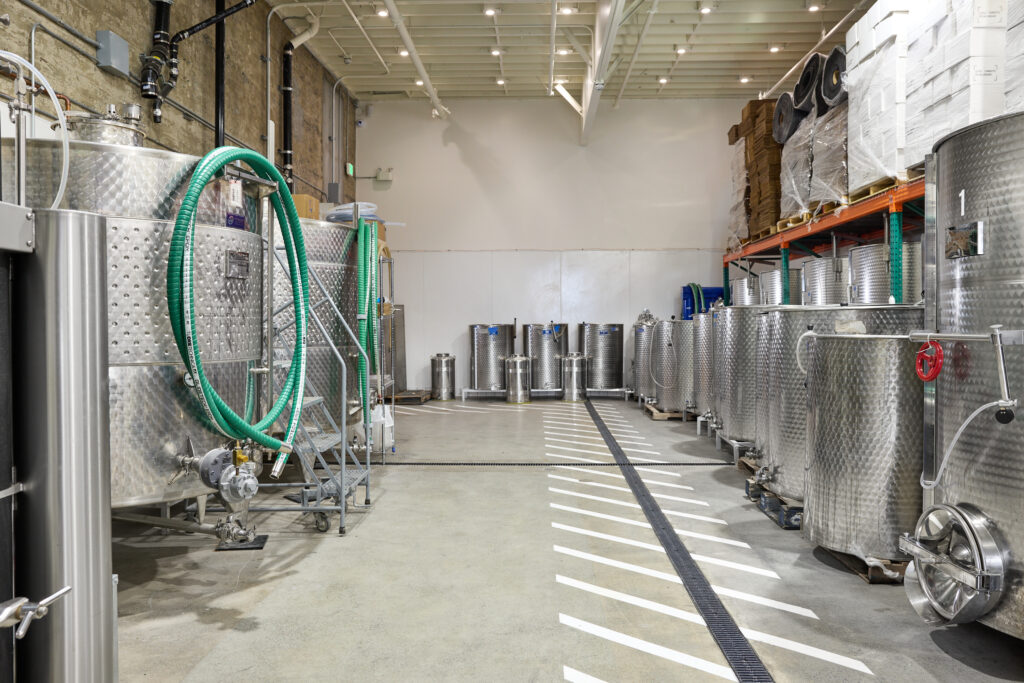
Say a craft distillery’s layout has three zones on one floor: fermentation, the still room, and a barrel aging room. Fermentation is a non-issue for MAQ — the wash is below the flash point threshold, so none of that volume counts against the allowance.
The still room is where MAQ actually applies. Between the still’s working volume and any day tanks or intermediate storage of high-proof distillate, it’s realistic for a small-to-mid-size operation to stay under 240 gallons of Class I-B/I-C liquid in that space — especially once it’s sprinklered. Kept as its own control area, the still room can plausibly remain Group F-1.
The barrel room is a special case worth calling out on its own, because it doesn’t follow the same MAQ math. Barrels and casks of distilled spirit are exempt from the MAQ chapters (IFC Chapters 50 and 57) altogether — per IBC 307.1.1, properly stored barrel and cask storage isn’t classified as H-3 on that basis. That’s genuinely good news for anyone assuming a barrel warehouse is an automatic hazardous-occupancy fight. It’s also, worth flagging, an area where the code has been in flux: the 2021 IFC added a new Chapter 40 specifically for storage of distilled spirits and wine, and while it preserves the MAQ exemption for barrels, it introduces secondary containment language that isn’t entirely clear yet — a topic we’ve covered in more depth in a dedicated post on 2021 codes and barrel storage.
The practical lesson still holds even with the barrel exemption: still-room distillate and barrel storage are functionally different animals under the code, and treating them as separate spaces — rather than one combined production floor — keeps each one’s compliance path clean rather than muddying the still room’s MAQ calculation with barrel inventory it doesn’t actually need to include.
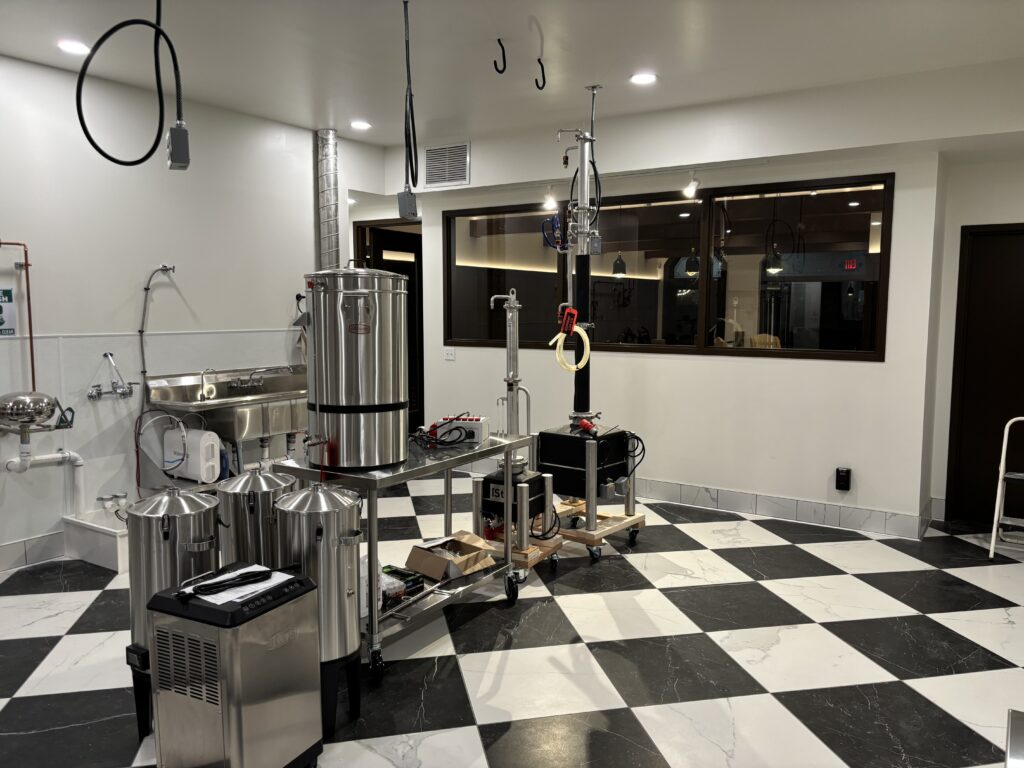
Exceeding the allowable quantity for your control area doesn’t mean the project stops — it means the code requires you to build for the actual hazard level present. That typically brings:
None of this is a dead end — plenty of larger distilleries are legitimately classified as H-occupancy and designed accordingly. The point is that it should be a deliberate design decision, made with full knowledge of the cost and code implications, not something discovered during plan review.
Everything above reflects the 2018 I-Codes, which remain widely adopted and are the baseline most jurisdictions are still working from. But MAQ treatment for distilleries isn’t static:
The practical implication: before you run any MAQ numbers, the first question is which code edition your jurisdiction has adopted — and even then, don’t assume adoption means adoption without amendment. This is one of the clearest examples in our world of why “the code says X” is never a complete answer without also asking “which code, and whose.”
MAQ calculations depend on production volume, storage strategy, and proof — all things that are usually still evolving when a distillery client first comes to the table. That’s exactly why this conversation needs to happen early. Get the control area strategy right at the concept stage, and F-1 occupancy stays achievable even as production scales. Get it wrong, and a permit set can get sent back to the drawing board after months of design work.
If you’re planning a distillery and want to know where your MAQ numbers land before you commit to a floor plan, that’s exactly the kind of code consulting we do at Dalkita — reach out and let’s pencil it out together.
Schedule a consultation or download our free Distillery Design Guide to get oriented on the key design and code considerations before your first meeting.
Dalkita Architecture & Consulting works with craft distilleries across North America, providing full-service architectural design, life safety consulting, and code compliance support from site selection through certificate of occupancy.
This post is part of our Code Intelligence Series, where we break down the building and fire code concepts that shape distillery and specialty occupancy design. Read next: MAQs (Maximum Allowable Quantities) and Using Control Areas to Maximize MAQs in Distilleries.
Article By: Matthew Taylor-Rennert