
Opening a craft distillery is one of the most exciting — and complicated — building projects you can take on. The passion is there from day one. The vision is clear. But somewhere between signing the lease and pouring your first barrel, most owners hit a wall they didn’t see coming.
After working with distilleries across North America, we’ve heard the same surprises come up again and again. Here are five things we wish every distillery owner knew before they broke ground.
This is the one that stings the most, because by the time we hear about it, the clock is already running.
A distillery isn’t like a restaurant or a retail space. The building — its layout, its construction type, its fire suppression systems, its egress — all of it is shaped by how much flammable liquid you plan to store and process. That analysis needs to happen before you commit to a space, not after.
We’ve had owners come to us excited about a space they’ve already signed on, only to discover that the building can’t accommodate their production volume without a full sprinkler retrofit, or that the zoning doesn’t allow their occupancy classification. Those are expensive surprises when you’re already paying rent.
The fix: Get an architect or life safety consultant on the phone before you sign anything. Even a one-hour conversation can tell you whether a space is viable.
A common assumption we hear: “We opened a restaurant in 18 months — how different can a distillery be?”
Very different.
Distilleries fall under F-1 industrial occupancy in the building code, with flammable and combustible liquids classified as hazardous materials. Many building departments — especially in smaller jurisdictions — have never reviewed a distillery permit before. Your project may be the first one they’ve seen. That means longer review cycles, more back-and-forth, and sometimes, plan reviewers who need to be walked through the code themselves.
Add in state liquor authority approvals, health department sign-offs, and fire marshal review, and you’re looking at a permitting timeline that can stretch well beyond a year in some jurisdictions. Plan for it. Budget for it. Don’t promise your investors a grand opening date until you have permit approval in hand.

This one surprises almost everyone.
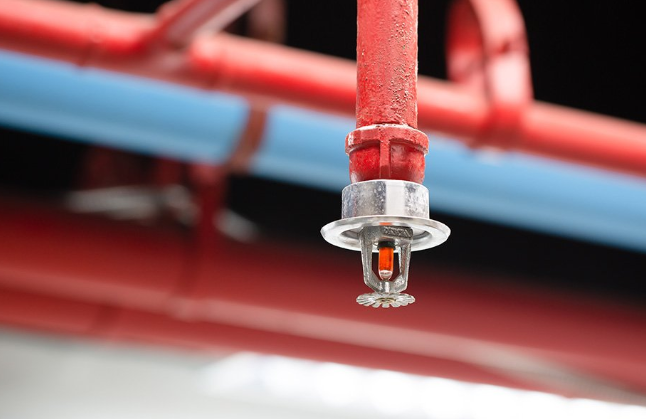
Yes, building size can trigger a sprinkler requirement — but for distilleries, that’s often not the deciding factor. Sprinkler requirements can also be triggered by the quantity of flammable and combustible liquids you’re storing and handling, what the building code calls Maximum Allowable Quantities, or MAQs.
Exceed those thresholds, and you’re required to install a full NFPA 13 sprinkler system — regardless of whether you’re in a 2,000 SF warehouse or a 20,000 SF facility. We’ve seen owners plan a modest operation in a small building, assume they wouldn’t need sprinklers, and then realize mid-design that their production targets pushed them over the MAQ limit.
This is why it’s worth reframing how you think about sprinklers when evaluating a space. A building that’s already sprinklered isn’t necessarily a higher cost — in fact, it can be the opposite. A sprinklered building often gives you significantly more freedom: higher MAQ thresholds, more flexibility in how you lay out your production and storage areas, and fewer costly code workarounds. If you’re choosing between two comparable spaces and one already has a sprinkler system, that’s a meaningful advantage worth factoring into your decision.
There are also code tools — like control areas — that can help you work within MAQ limits strategically in an unsprinklered building. But that analysis needs to happen early in the design process, not as an afterthought.
AHJ stands for Authority Having Jurisdiction — your local building official and fire marshal. In major metro areas, they may have reviewed dozens of distillery projects. In smaller towns and rural jurisdictions, yours might be the first.
That’s not a knock on anyone. But it does mean you shouldn’t assume the reviewer will know how the code applies to your project. We’ve seen plan review comments that reflect a misapplication of residential or restaurant code standards to a distillery — because that’s what the reviewer knew best.
Part of our job is to anticipate this and front-load the permit drawings with clear code narratives, occupancy analysis, and hazardous materials documentation. When you hand a reviewer a package that explains the code as it applies to your specific project, the review goes faster and smoother.
If there’s one line item that consistently catches distillery owners off guard, it’s mechanical.
A distillery isn’t a typical commercial space. You’re handling flammable vapors, which means ventilation isn’t just about comfort — it’s a life safety requirement. Depending on your setup, you may need specialized exhaust systems designed to keep vapor concentrations below dangerous levels, and HVAC that’s engineered around your production process rather than just the square footage of the building.
Here’s something many owners don’t learn until it’s too late: classified / explosion-proof electrical equipment is not always required. It’s a common assumption — and a very expensive one. The requirement for explosion-proof electrical can actually be eliminated through proper ventilation design and engineering calculations that demonstrate vapor concentrations remain below 25% of the Lower Flammable Limit (LFL). If your ventilation system can prove that threshold is maintained, the hazardous location classification goes away, and so does the requirement for explosion-proof fixtures, motors, and equipment.
We have this conversation regularly with distillery owners — and unfortunately, we sometimes have it too late. Owners who didn’t work with a team experienced in distillery design often spend tens of thousands of dollars on explosion-proof electrical, only to find out afterward that a well-designed ventilation system would have made it unnecessary. That’s real money left on the table.
The mechanical budget for a distillery can still be significant — the engineering, the exhaust systems, the ventilation design — but it should be money spent on the right things. The earlier you get a mechanical engineer with distillery experience involved, the better positioned you are to make those decisions deliberately rather than by default.

If you’re in the early stages of planning a distillery — or even just kicking the tires on a space — our Distillery Design Guide is a great place to start. It covers the key design and code considerations you’ll face, in plain language, before you’ve spent a dollar on design fees.
And if you’re ready to dig into the specifics of your project, reach out to us directly. We work with distilleries across North America and we’re happy to talk through what you’re building.